

Research has always been the slow part of strategy work. AI market research uses artificial intelligence, mainly large language models, natural language processing and machine learning, to gather, sort and analyze market information faster than manual methods allow. It speeds up jobs like desk research, survey and review analysis, social listening and competitor audits. The decisions still belong to people. AI finds patterns, and strategists work out what they mean.
When speed and precision decide who wins a market, traditional research methods on their own often can’t keep up. At Daylight, we’ve built AI into our strategy workflows to back up our people, not replace them. Our clients get answers sooner, with clearer direction.
This post explains what AI market research can and can’t do, the main use cases and tool categories, the risks to manage, and how we use it to find what matters, from shifting customer sentiment to gaps nobody in your industry has filled yet. AI is one of the services we offer as a digital product and experience agency. We use it to speed up the people doing the thinking, not to automate them away.
Why does AI-powered market research change the game?
Most agencies still rely on manual research: competitor audits, content reviews and scattered audience surveys. These methods work, but they take time, and the findings are often out of date by the time they’re finished.
We use AI to speed up research cycles, analyze larger data sets in less time and pull out the relevant signals faster. That shift lets our strategists spend less time gathering information and more time putting it to work.
We’re after sharper insight. More data only helps if it gets us there.
How is AI used in market research?
AI is most useful where research involves a lot of unstructured text or a lot of sources. These are the most common use cases:
Survey and open-ended response analysis
Coding hundreds of open-ended survey answers or interview transcripts by hand takes days. AI can transcribe, summarize and group responses into themes in a fraction of the time, and it can review a draft survey for leading questions or unbalanced answer options before it goes out. A researcher should still spot-check the themes against the raw responses.
Social listening and review mining
Reviews, forums, Reddit threads and social posts are full of unfiltered customer language. AI can scan large volumes of it to surface recurring complaints, praise, unmet needs and the exact words customers use, which is valuable input for messaging and product decisions.
Competitor research
AI can compare competitors’ websites, positioning statements, pricing pages and reviews side by side, then highlight overlapping claims, gaps and tone differences. It turns a competitor audit from a multi-week spreadsheet exercise into a faster first pass that strategists can then dig into.
Persona building
AI can help draft audience personas by pulling together patterns from interviews, survey data, reviews and analytics. Treat these as hypotheses, not findings. Some tools now offer “synthetic respondents” that simulate customer answers. They can help you sharpen questions, but they reflect training data, not your actual customers, so they should never replace talking to real people.
Trend spotting and desk research
AI assistants can summarize long industry reports, scan news and commentary, and flag emerging topics across sources. This is where AI often saves the most time early in a project, as long as every important claim is traced back to its original source.
What types of AI market research tools are there?
The market changes quickly, so it helps to think in categories rather than brand names. Most teams combine a few of these:
- General-purpose AI assistants (such as Claude, ChatGPT and Perplexity): fast desk research, summarization, categorization and brainstorming. Tools that cite sources make verification easier.
- Survey platforms with AI analysis: help write questions, analyze open-ended answers and summarize results.
- Social listening platforms: track brand, competitor and topic mentions across social media, news and review sites, with sentiment analysis.
- Qualitative analysis and transcription tools: transcribe interviews and focus groups, tag themes and pull out representative quotes.
- AI-moderated research tools: run conversational interviews or concept tests at a larger scale than a team could moderate live.
- Synthetic data and persona tools: simulate audience responses for early exploration. Use with caution and validate with real people.
Before adopting any tool, check where your data goes, whether it’s used for model training and whether the tool shows its sources. A low-cost general assistant is often enough to test a workflow before you invest in a specialized platform.
How Daylight uses AI to accelerate market research
New tools come out constantly, so we hold ourselves to a process. Here’s how we apply AI strategy consulting to the research process.
Rapid discovery with Claude and Perplexity
We use tools like Claude and Perplexity to get the lay of the land quickly, scanning industry reports, forums and social commentary to identify emerging patterns in customer needs, brand positioning and competitor claims. These tools allow us to:
- Summarize complex research reports in minutes
- Ask exploratory questions across broad sources
- Surface insights from data that would otherwise take hours to find
Clarity through categorization
Once information is gathered, we use AI to group findings into categories and themes. This helps us:
- See trends in language and tone across competitors
- Identify messaging blind spots or overused claims
- Turn qualitative inputs into structured material for strategy
Data in, strategy out
This part is ours. AI can point to patterns, but only people can say what they mean in the real world. Our strategists translate AI-supported insights into brand recommendations, messaging hierarchies and go-to-market plans tied to business goals.
“AI helps us accelerate the front end of the research process, but its real value is how it frees us up to focus on the interpretation. The faster we can spot themes and friction points, the faster we can start crafting a strategy that actually solves problems — not just reacts to them.”
Alan Robinson, Director of Strategy at Daylight
3 quick tips for smarter AI-powered research
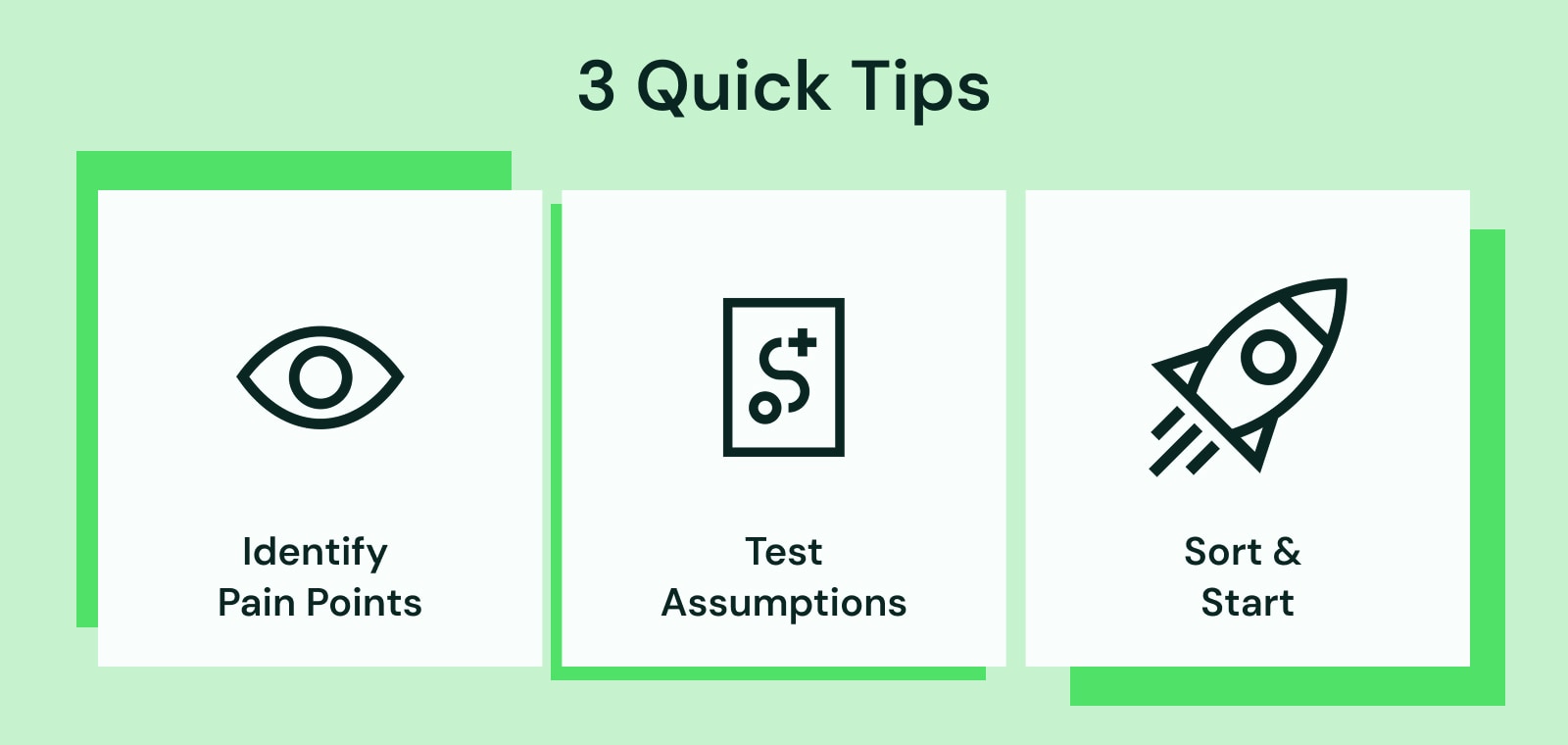
Good insights start with good questions and the right tools to answer them. Here are three lessons we’ve learned while using AI to speed up and sharpen the research process.
1. Prompt for tension, not summaries.
When using tools like Claude or Perplexity, we often ask things like:
“What do customers seem most frustrated by in reviews of [competitor]?” or “What conflicting opinions show up about [topic] across Reddit and G2?”
Prompts like these turn up real pain points instead of surface-level takeaways, and pain points are far more useful when shaping messaging or product positioning.
2. Use AI to pressure-test your assumptions.
Instead of only using AI to gather data, we use it to challenge internal hypotheses. For example:
“What are the counter-arguments to [Client’s] core value proposition?”
It helps us see objections coming, sharpen positioning and build strategies that hold up.
3. Organize findings by decision-making impact.
It’s easy to collect far more data than you know what to do with. We triage insights into three buckets:
- Quick wins (immediate UX/messaging tweaks)
- Strategic shifts (brand, value props, audience targeting)
- Future investigations (interesting, but not urgent)
That keeps us focused and keeps the research from stalling the project.
LET'S PARTNER
Book Your AI Strategy Session Today
Let’s explore how your business can uncover sharper insights, faster — and turn them into action. Whether you’re building a new brand or refining your position in a competitive market, we’ll help you use AI where it matters most.
What are the limits and risks of AI market research?
AI makes research faster, but it also makes it easier to be confidently wrong. These are the risks we plan around on every project:
- Hallucination: AI models can produce plausible but false statements, invented statistics or citations that don’t exist. Every number and claim that informs a decision needs to be checked against its original source.
- Bias: models reflect the data they were trained on. Online conversation over-represents some audiences and under-represents others, so AI summaries can echo the loudest voices rather than your actual market.
- Data privacy: pasting customer data, interview transcripts or confidential strategy into a tool can expose it. Check each tool’s data retention and training policies, and remove personal information before analysis.
- Outdated or missing information: a model’s knowledge stops at a point in time, and many sources sit behind paywalls or logins it can’t see.
- Black-box reasoning: it isn’t always clear how a tool reached a conclusion, which makes findings hard to defend without source evidence.
- Synthetic answers aren’t customers: simulated respondents can’t tell you what your real buyers will do.
None of these risks is a reason to avoid AI. They’re a reason to use it with a plan. As we wrote in the truth behind MIT’s “95% AI failure” claim, most AI efforts stumble because of missing strategy, integration and accountability, not because the technology doesn’t work.
What does a human + AI research workflow look like?
The most reliable approach gives AI the speed work and keeps people in charge of judgment. A simple workflow looks like this:
- Define the decision. Start with the business question the research needs to answer, not the tool.
- Gather broadly with AI. Use AI for desk research, review mining and competitor scans to map the market quickly.
- Verify. Trace key claims to original sources, and check AI-generated themes against raw data.
- Talk to real people. Use interviews, surveys or usability tests to confirm or overturn what the AI surfaced.
- Interpret and prioritize. Strategists decide what the findings mean and triage them into quick wins, strategic shifts and future investigations.
- Act and document. Feed insights into brand, UX and go-to-market work, and record where AI was used.
What clients gain from this approach
Clients get three things out of this:
- Speed to clarity: we deliver usable insights faster, with no drop in quality.
- Deeper analysis: AI helps us scan more sources and catch details others miss.
- Smarter strategy: insights flow straight into creative, brand and UX recommendations instead of getting stuck in a slide deck.
For a client launching a new brand or repositioning an existing one, that means decisions backed by evidence instead of guesses.
Our principles for responsible AI use
We don’t believe in AI for AI’s sake. When we consult on AI strategy, we work by three principles, which are part of our broader responsible AI principles:
- AI should enhance human insight, not replace it.
- We’re transparent with clients when AI is part of the process.
- We use privacy-first, responsible tools that respect data integrity.
They keep our use of AI practical and in our clients’ interest.
Will AI replace market researchers?
No. AI supports human strategy rather than replacing it. It’s very good at the front end of research, meaning the collecting, summarizing and sorting. It can’t judge which insight matters for a specific business, weigh it against brand, budget and timing, or build the trust needed to act on it. At Daylight, we use it to move faster so our clients can stay a few steps ahead.
For teams wondering where AI fits their own work, our AI Readiness Assessment shows where AI would actually help your day-to-day workflows and where it’s only hype, and you can schedule an AI strategy meeting to start that conversation.
Let AI do the gathering and sorting, and keep people on the questioning, verifying and deciding. That’s when AI market research is both fast and worth acting on.
Our Clients