

The short answer
Most AI implementation challenges are business problems rather than technology problems. The common AI implementation pitfalls are an unclear goal, data that isn’t ready, tools chosen before the workflow, weak integration with legacy systems, a skills gap, low adoption, missing AI governance and no way to prove value. Most of them are avoidable with a readiness assessment, one measurable pilot and a baseline recorded before anything is built.
Which AI implementation challenge is holding you back?
Start from the symptom you’re seeing. Find the row that sounds like your project; our AI strategy services start from the same questions.
| What you’re seeing | The real challenge | First fix |
|---|---|---|
| Lots of AI ideas, no agreement on which one | No defined business problem | Pick one problem and one metric |
| The demo worked, the pilot didn’t | Data or integration | Audit the data and the systems it must connect to |
| A tool was bought, and few people use it | Adoption | Redesign the workflow with the people doing the work |
| Leadership asks what it’s worth | No baseline or KPIs | Record today’s numbers, then measure the pilot against them |
| Teams use AI tools nobody approved | Governance | Approved tools, data rules and human review |
Why do AI projects fail?
AI projects fail mostly for reasons that can be planned for. A 2024 RAND report notes that by some estimates more than 80% of AI projects fail, about twice the rate of IT projects without AI. After interviewing 65 experienced data scientists and engineers, RAND named five root causes, and the most common was a misunderstanding about what problem the AI was meant to solve.
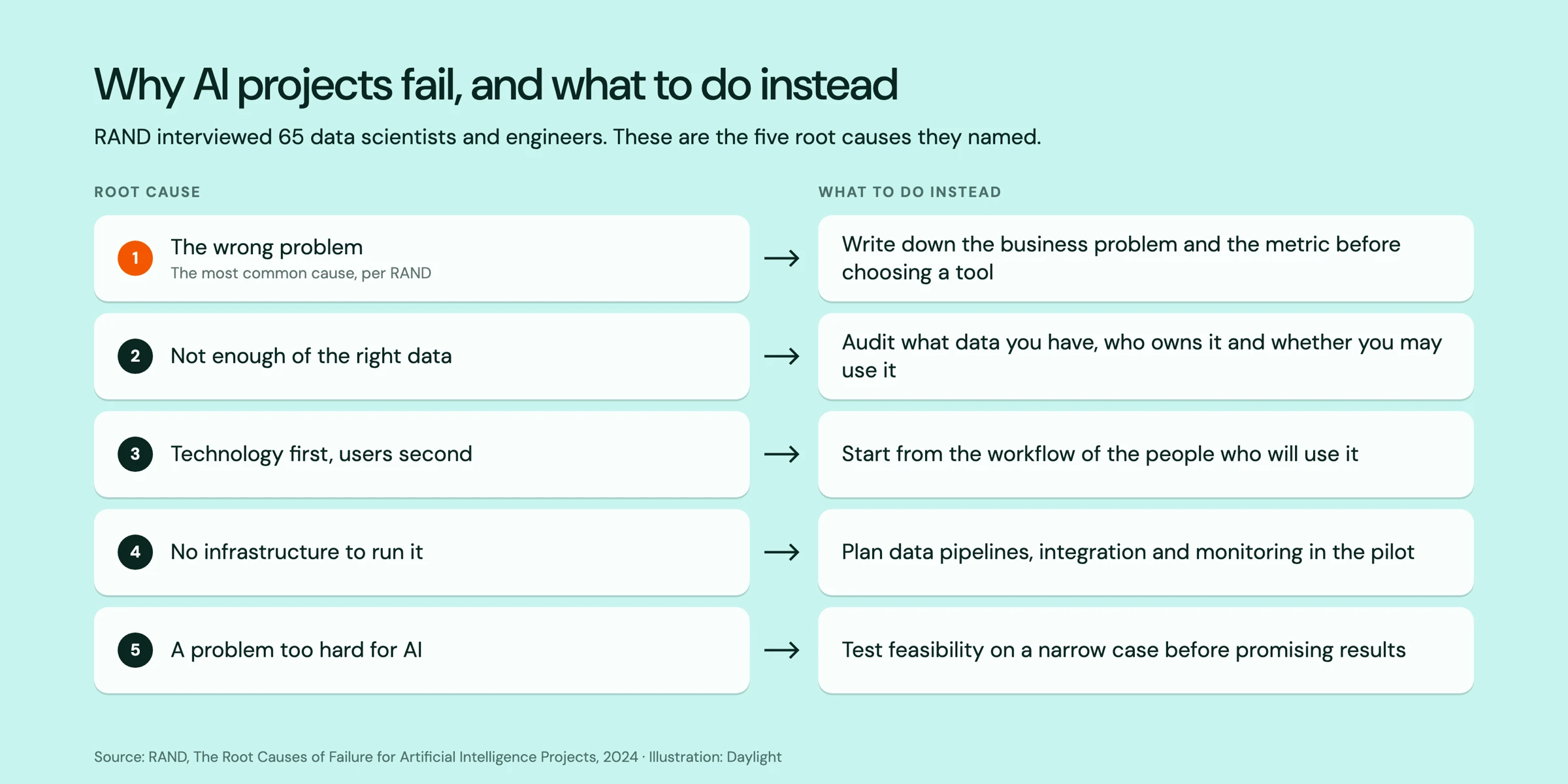
We see the same pattern in the claim that 95% of AI pilots fail, which we unpack in the truth behind MIT’s 95% AI failure claim: pilots stall when they lack a clear use case, real integration and someone accountable for results.
What are the biggest AI implementation challenges?
The same challenges of AI implementation appear across industries and company sizes, and they usually surface in roughly this order.
1. No clearly defined business problem
Many AI initiatives start with “we should use AI” instead of a specific business goal, such as reducing support response time by a third. Without a defined problem and a metric, scope drifts, priorities compete and nobody can say whether the AI solution worked.
2. Data that isn’t ready
Every AI system depends on the quality of its data, whether that’s training data for a custom model or the documents and records an assistant retrieves. Organizational data is often incomplete, duplicated or spread across systems that don’t share information, and sometimes you don’t have permission to use it for the intended purpose. Good data management starts with an audit of what exists, who owns it and how reliable it is.
3. Choosing the tool before the workflow
Purchasing the newest AI tools and then searching for a use is how projects end up solving problems nobody has. Map the work people actually do first, then decide where AI models, automation or AI-powered features would genuinely improve it.
4. Weak integration with existing systems
A tool that sits outside the CRM, ticketing system or CMS people use every day adds steps, and people quickly work around extra steps. Integrating AI with legacy systems often requires APIs, middleware and data cleanup, so plan the integration, data flows and continuous monitoring as part of the pilot rather than after it.
5. A skills gap on the team
Many teams haven’t yet developed the data science and engineering skills to scope, evaluate and maintain AI systems. External specialists can close the gap, but the plan should leave your own people able to operate and improve what gets built.
6. Low adoption
Even a well-built tool fails when nobody uses it. Employees distrust output they can’t verify, worry about their roles or don’t see how the tool fits their daily responsibilities. Treat the rollout as change management: involve users early, train them on real tasks and give them a simple way to report problems.
7. Missing governance and security rules
AI raises questions that most software doesn’t: which data may be shared with third-party models, who reviews the output and who is accountable when it’s wrong. Set approved tools, data rules and human review for anything customer-facing before you scale; our responsible AI principles show how we approach it.
8. No way to prove value
This is the challenge organizations mention most often, and it’s usually a consequence of the other seven.
49%
of organizations say estimating and demonstrating the value of AI is their biggest barrier to adoption, ahead of talent, technical and data issues.
How do you prove the value of an AI project?
Measure it like any other investment: record a baseline before you start, pick one or two KPIs that matter to the business, and compare the pilot against them. Good baselines are specific, such as minutes per support ticket, cost per invoice processed or the conversion rate of a form, and the full cost of ownership includes integration, training and monitoring, not just licenses.
1 in 5
Fewer than one in five organizations track KPIs for their generative AI solutions, even though tracking well-defined KPIs had the strongest link to bottom-line impact of any practice studied.
Source: McKinsey, The State of AI, 2025
What does a successful AI rollout look like?
A successful AI strategy moves in stages and doesn’t advance until each stage proves itself. Readiness comes first, then one narrow pilot with real users and real data, then integration into the systems people already use, and only then do teams scale AI to a second use case and deploy AI more widely.
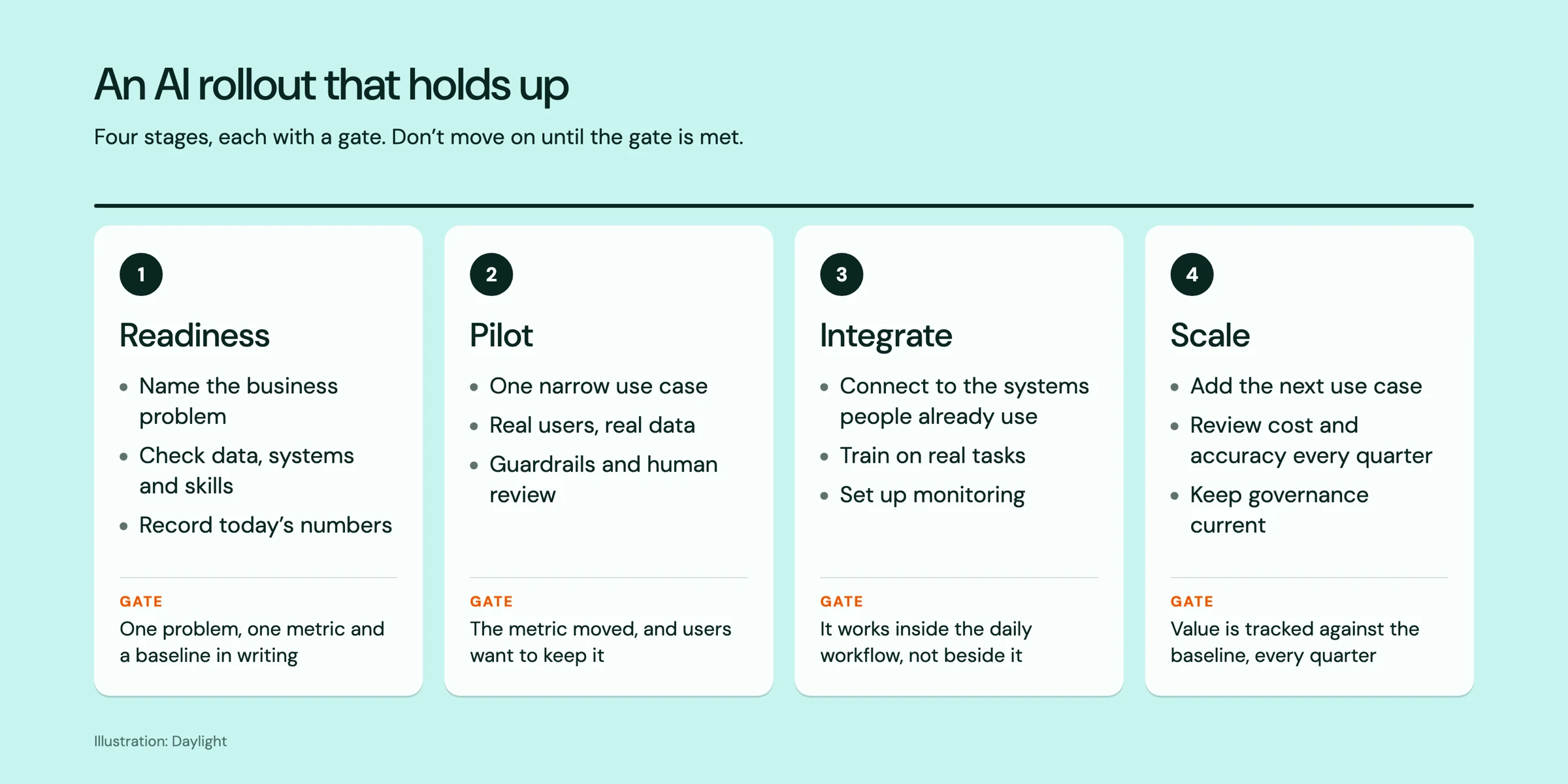
Before the pilot starts, check these off:
- The business problem and its success metric are documented.
- Today’s numbers are recorded as the baseline.
- The data has been audited for quality, ownership and permission to use.
- The pilot covers one use case, with real users and real data.
- Integration with existing systems is part of the pilot plan.
- Approved tools, data rules and human review are in place.
- Users have been trained on their own tasks, with a way to report problems.
- A review date is set to evaluate results and decide whether to scale.

From our work: Meadow Outdoor
75%
fewer calls and challenges about invoice charges
100%
savings on envelopes, paper and stamps for contract copies
This was a custom operations system, not an AI project, but the adoption lesson is the same. We built Meadow Outdoor’s database around each department’s own process requirements, with automated reminders and one-click reports instead of spreadsheets.
Should you hire an AI implementation consultant?
Hire one for the parts your team hasn’t done before, usually the readiness assessment, the pilot design and the first integration, and make sure the work leaves your own people able to run it. Skip consultants who lead with a tool or promise results before they’ve seen your data. A good partner starts with your business problem, shows case studies with real numbers and plans for adoption, not just deployment.
Frequently asked questions
What is the most common reason AI projects fail?
According to RAND’s 2024 research, the most common reason is that stakeholders misunderstand or miscommunicate the problem the AI is supposed to solve, so the model is optimized for the wrong thing or doesn’t fit the business workflow.
How do you know if your data is ready for AI?
Check four things: whether the data you need exists, whether it’s accurate and consistent, whether it’s reachable from the systems the AI will use, and whether you have permission to use it for this purpose. If any answer is no, fix that before choosing a model.
What should an AI pilot measure?
One or two business KPIs compared with a baseline recorded before the pilot, such as time per task, cost per transaction or conversion rate, plus adoption: how many of the intended users actually use it each week.
Planning an AI project or stuck in a pilot? Tell us what you’re trying to solve and we’ll tell you where we’d start, or see our AI strategy services first.

Portland digital agency since 2002
Our Clients