

The short answer
The best wine ecommerce platform for most established wineries is Commerce7, vinSUITE, OrderPort or eCellar, paired with Sovos ShipCompliant for shipping compliance. Small or new producers usually do better on Vinoshipper, which handles compliance for them. If you still run WineDirect Classic, it shuts off on December 31, 2026.
Which winery ecommerce platform should you start with?
Start with the kind of winery you run. Find the row that sounds like you.
| Your winery | Where we’d start | Why |
|---|---|---|
| New or small, few state permits | Vinoshipper | No monthly fee, and compliance is built in |
| Tasting room with a local club | Commerce7 Lite or OrderPort | POS and club on one customer record, $0 to $150 a month |
| Mid-size, the club drives revenue | Commerce7, vinSUITE, OrderPort or eCellar | All four handle member self-service; compare fees and how each connects to your site |
| Allocations or several brands | eCellar or Commerce7 Basic | Both support allocations |
| Still on WineDirect Classic | Commerce7 or eCellar, and start now | Both advertise free migration from WineDirect |
What does a wine ecommerce platform need to do?
Ecommerce for wineries runs four jobs that share one customer record: the online store, wine club management, the tasting room POS and shipping compliance. Shipping wine is the hard part. A bottle may not be legal to send to the buyer’s ZIP code, and the buyer is often a club member who bought two cases in the tasting room last month.
Most winery software handles the first three and hands wine shipping compliance to Sovos ShipCompliant. Vinoshipper handles compliance itself.

What is the best ecommerce platform for wineries in 2026?
Four winery ecommerce solutions make most shortlists, plus Vinoshipper for smaller producers. All of them run the store, club and tasting room, so the table sorts them by who each one suits.
| Platform | Pick it if | Watch for | Starts at |
|---|---|---|---|
| Commerce7 | You want pricing that grows with revenue and have a designer to style the store | A fee on sales from the Basic tier up; no design services | $59 a month |
| vinSUITE | You want club, POS, ecommerce and CRM from one company | Annual commitment; $999 implementation | $249 a month |
| OrderPort | You don’t want to hand over a percentage of every sale | Checkout and account pages stay on OrderPort’s hosted pages | $0 a month, onboarding from $1,000 |
| eCellar | You sell by allocation or run several brands | The highest entry price of the four | $450 a month |
| Vinoshipper | You’re small or new and don’t hold permits in many states | A cut of every order instead of a monthly fee | $0 a month |
Shopify can sell wine online only with a compliance layer such as Vinoshipper connected to it. It suits wine brands that sell a lot of merchandise; club-heavy wineries usually do better on a wine-specific platform.
What changed this quarter · October 2026
WineDirect Classic shuts down on December 31, 2026, and WineDirect now points its customers to Commerce7. We rechecked every price in this article on each vendor’s site in October 2026.
What does a winery ecommerce platform cost per year?
A year on these platforms costs roughly $1,000 to $18,000 at $250,000 in online sales, before card processing on most of them. The monthly price is the smallest part once a platform takes a share of each sale. Here’s a year on each platform at two sales levels, using only the prices on each vendor’s own pricing page, checked in October 2026. Daylight doesn’t resell any of these platforms.
| Platform | Monthly price | Fee on each sale | First year at $250K in online sales |
|---|---|---|---|
| Commerce7 | $149 (Basic plan) | 1.5% | $5,538 |
| vinSUITE | $249, annual plan | Not published | $3,987, including $999 setup |
| OrderPort | $0 or $150 | None | $1,000 to $2,800, including onboarding |
| eCellar | $450 to $1,250, by sales band | None | $5,400 to $15,000 |
| Vinoshipper | None | 1.85% plus $0.75 a bottle | About $18,100, with card processing and compliance included |
Except for Vinoshipper, these totals leave out card processing and compliance, which you pay on top. At $1 million in online sales the gap widens: Commerce7 moves to its Pro plan ($399 a month plus 1%), about $14,788 a year, and Vinoshipper comes to about $72,500.
Expect Commerce7 to cost more than the table shows. Its billing documentation says the fee is based on the previous 30 days of gross revenue, including tax and shipping. It also processes cards through Fullsteam and doesn’t publish that rate, so ask for it in writing before you compare. Vinoshipper’s figures assume an average of $30 a bottle and include its 2.9% card fee and compliance, which you’d pay for separately elsewhere.
How does a winery store connect to WordPress or Craft?
In one of three ways, and the choice shapes design, search and tracking. Embedded widgets run the platform’s JavaScript inside your own pages and keep checkout on your domain. A hosted store lives on the vendor’s domain or a subdomain, with design limited to their theme. A custom build pulls platform data through an API, so you control design and URLs and build the tracking yourself.
Whichever wine ecommerce software you pick, test that Google can see your product pages, keep your performance plugins from caching the store’s scripts, and set up cross-domain tracking in GA4 if checkout lives on another domain. Our guide to getting your wine found on Google covers the search side, and how we build winery websites covers the rest.

What happens if you’re still on WineDirect Classic?
You need to move before December 31, 2026. Commerce7’s owner agreed to buy WineDirect’s software in early 2025, and Wine Industry Advisor has the details. Commerce7 offers free data migration and about six to eight weeks of onboarding; eCellar also advertises free migration.
Count eight weeks back from December 31 and you land on the fall club shipment and holiday orders. Only the cart, checkout and member pages move. Your website content stays where it is. If you’re on that clock, tell us your platform and launch date and we’ll tell you what to move first.
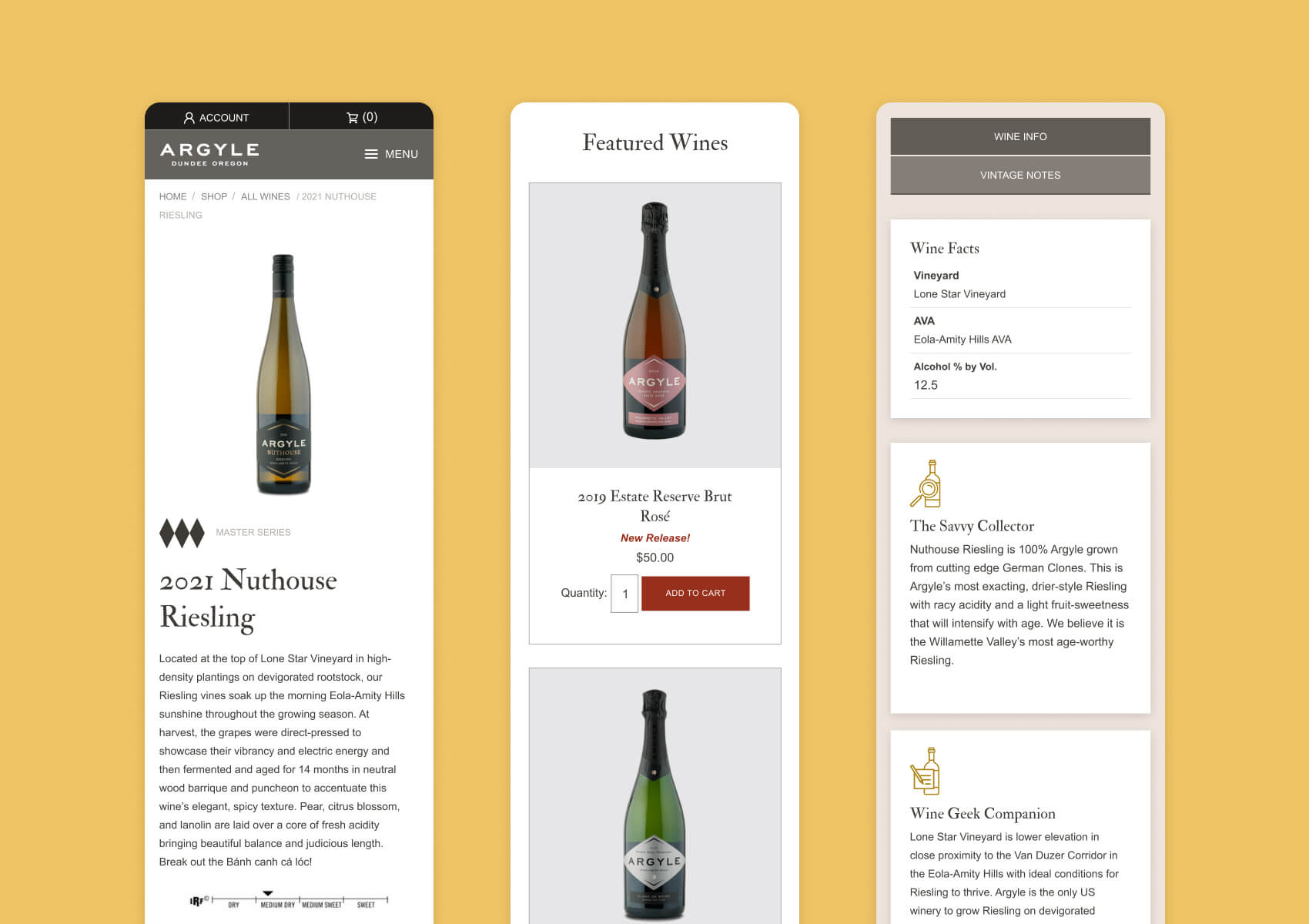
Client spotlight: Argyle Winery
+44%
revenue
+22%
purchases
+767.5%
mobile revenue
Argyle’s store had to keep running on vinSUITE while wine descriptions changed every season. We built a block-based CMS where the team writes each wine story once and reuses it across the site, while vinSUITE runs the cart. Mobile conversion rose 464.1%. All figures compare the 90 days after launch with the same period a year earlier.
Should you replatform and redesign at the same time?
No. Move the store, club and POS first so winery operations keep running, style the new pages to match your current site, redirect the old URLs and get through the holidays. Save the redesign for the new year. Change both at once, and if revenue dips, nobody can tell which change caused it.
Frequently asked questions
Do I need a separate compliance service?
On Commerce7, vinSUITE, OrderPort and eCellar, yes: most wineries connect Sovos ShipCompliant. Vinoshipper is different: it checks each order against state rules for you, and that’s part of what you pay for.
Does my wine club move with me when I switch?
Members and club history do, if you export everything first: customers, orders, products, gift cards and stored cards. Get in writing which of those import. A stored card that doesn’t transfer becomes a failed charge on the next club run.
Can my current winery website stay when I change platforms?
Yes. Your pages, wine stories and photos stay put. Only the store, checkout and member pages change, so plan the redirects for those URLs and restyle them to match the site.
Choosing or moving a winery platform? Tell us about your winery and we’ll tell you where we’d start. Want to see our work first? See how we help wineries.

CEO, Founder

Do 95% of AI Pilots Really Fail? The Truth Behind the MIT Study
MIT says 95% of AI pilots show no return. Here’s what the study really measured, what newer research shows and what the 5% do differently.